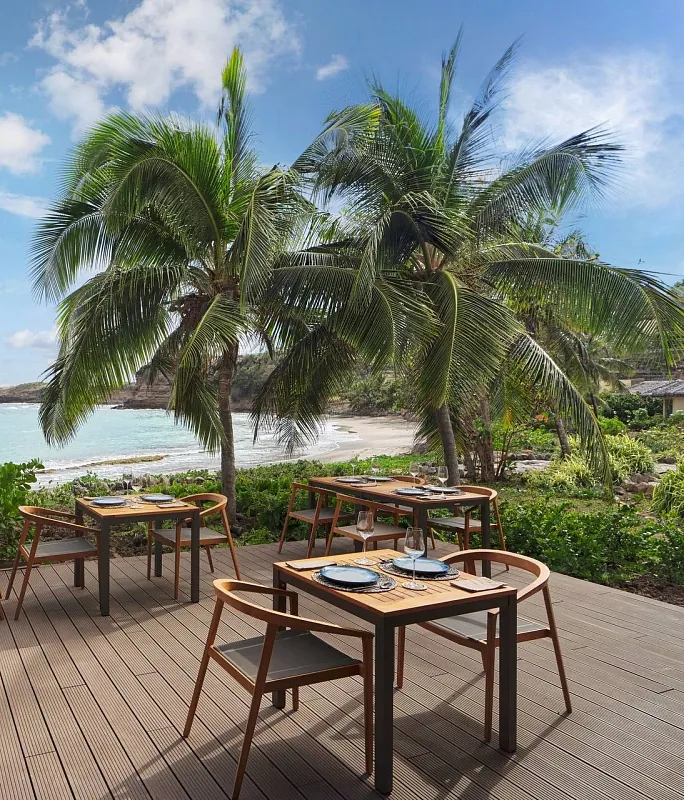
REVIVE Roças is a national São Tomé and Príncipe program for restoring 29 historic colonial plantations (known locally as "roças") through long-term concessions of 40-50 years, with a total budget of around 50 million EUR and expected returns of 8-12%. The program gives investors access to heritage sites, tax incentives and green financial instruments, and aims to develop São Tomé and Príncipe as a notable destination for quality ecotourism in Portuguese-speaking Africa.
Letters of intent are being accepted until June 2026, and pilot implementation of the program is planned for 2026-2028: 8 plantations have been selected, one of which has been designated the pilot site.
Below we look at why restoring these plantations is becoming a new entry point for investors into sustainable tourism.
What Is REVIVE Roças?
REVIVE Roças is a government program to rehabilitate former colonial-era cocoa and coffee plantations, which today represent a unique architectural and cultural asset of the country. Inspired by the Portuguese "Revive" model, it reimagines these sites as:
- boutique hotels;
- interpretation centers;
- agrotourism farms;
- eco-lodges.
By 2030, the plan is to restore 8-10 buildings, create around 1,000 jobs, and increase tourism revenue by 25%. The program is coordinated by the Ministry of Environment and Tourism together with the Investment Promotion Agency, with support from the UN, Portugal and the African Development Bank. It is embedded within the country's national strategic framework - the National Development Plan for 2025-2039 and the National Sustainable Development Strategy for 2026-2040 - which gives the initiative institutional durability.
The context makes the project particularly attractive: São Tomé and Príncipe is home to two UNESCO biosphere reserves - Príncipe Island and São Tomé Island. The core of the São Tomé Island biosphere reserve is Obô Natural Park, and the archipelago as a whole has a very high level of endemism.
Terms for Investors: 40-50 Year Concessions and Tax Incentives
The core of the offer is long-term concessions of 40-50 years, allocated through open public tenders. The next stage of the program includes tenders for concessions on 8 priority sites, with pilot implementation slated for 2026-2028, and one plantation already designated as the pilot project.
Among the announced incentives are tax breaks and financial instruments:
- a reduced corporate tax rate;
- exemptions from value-added tax and customs duties, though the time horizon for these still needs to be determined;
- access to green credit lines from the UN Development Programme, the African Development Bank and the European Union;
- public guarantees through the National Investment Promotion Fund.
The financial model is structured around a ratio of 60% private investment to 40% public and donor co-financing. Expected return on investment is 8-12%, internal rate of return is 10-15%, and payback period is 8-10 years. Letters of intent are accepted until June 2026 through the Investment Promotion Agency and the portal invest2025.gov.st.
Why Should Investors Consider REVIVE Roças?
São Tomé and Príncipe positions itself as a 100% organic country with no mass tourism - a rare combination on the world map of destinations. Africa's ecotourism market is growing at double-digit rates, and the archipelago offers something increasingly hard to find: untouched landscapes, zero overcrowding, and a genuine cultural layer.
For investors, this means several concrete advantages.
- First, low competition at entry: 29 sites is a limited resource, and early participants get the best locations.
- Second, the program's expected contribution to GDP is estimated at +2%, with a multiplier effect for local supply chains - cocoa, coffee, crafts, and gastronomy.
- Third, support from the Community of Portuguese Language Countries, the UN and European partners significantly reduces country risk and eases access to donor capital.
A social component also strengthens the project's ESG profile (environmental, social and governance criteria): program materials state that around 40% of the jobs created should go to women, while the environmental component of the project is tied to building restoration, developing green infrastructure, and environmental management plans.
Comparison With Other Tourism Investment Programs
To gauge where REVIVE Roças stands in the market, it is useful to compare it with neighboring jurisdictions.
| Program | Concession length | Incentives | Focus | Budget / returns |
| REVIVE Roças (São Tomé) | 40-50 years | Reduced IRC, IVA exemption, green loans | Ecotourism, historic heritage | 50 million EUR, ROI 8-12% |
| Caribbean (Grenada, St Lucia) | 5-99 years | Citizenship by investment from $90,000-200,000, duty-free import | Real estate, resort hotels | High, IRR 10-20%, visa perks |
| Cabo Verde | 20-30 years | Corporate tax of 5-10% for tourism | Mass-market and eco-segment resorts | Medium, oriented toward the EU market |
Caribbean schemes are attractive for their passport component, but carry geopolitical risks and are subject to pressure from international regulators on citizenship-by-investment programs. Cabo Verde offers shorter concessions and is geared toward a resort model. REVIVE Roças occupies its own niche: a long ownership horizon, genuine heritage, and sustainable ecotourism - a segment growing faster than mass-market beach tourism.
How to Take Part in the REVIVE Roças Project
The participation process is built around several steps:
1. Prepare a letter of intent with a rehabilitation concept for the site - the deadline for submission is June 2026.
2. Send the letter of intent through the Investment Promotion Agency or the official portal invest2025.gov.st.
3. Take part in meetings between business people and site visits to the plantations, organized by the Investment Promotion Agency.
4. Submit a tender application for one of the 8 priority sites, including a business plan, a financial model, and a plan for compliance with environmental standards.
5. If successful, sign the concession agreement and gain access to tax incentives and green financing.
It is critical to carefully think through the architectural concept: the program requires preserving the historical identity of the buildings, rather than replacing them with generic hotel formats.
Risks and Challenges of the Project
An honest assessment of the risks is part of due diligence.
- Economic. Dependence of tourist flow on the European market. This is mitigated by diversifying sources of demand (the Community of Portuguese Language Countries, Angola, Brazil, Gulf states) and guarantees from the National Investment Promotion Fund.
- Logistical. An island economy means higher import costs. This is partly offset by customs incentives under the program.
- Climate-related. Although the archipelago is outside the main hurricane belt, tropical rains and erosion call for investment in resilient construction solutions.
- Operational. Bureaucratic procedures. An inter-agency "REVIVE" team has been set up to simplify these, operating on a "single window" principle.
- Political. The country shows a high degree of stability in the regional context, but monitoring remains a mandatory part of risk management.
Conclusion
REVIVE Roças is not just a restoration project, but an institutional bet by São Tomé and Príncipe on becoming a benchmark for ecotourism in Portuguese-speaking Africa, under the slogan "EcoSTP - heritage with a future." For investors, rare factors come together here: a limited supply of unique sites, long concessions, tax and green financial instruments, a strong environmental, social and governance profile, and institutional backing from the UN, the European Union and the African Development Bank.
Submission of letters of intent is open until June 2026, and the next stage of the program involves tenders for the 8 priority sites and pilot implementation planned for 2026-2028.
Program São Tomé and Príncipe Citizenship →Questions about this article?
We'll look at your situation and suggest the next step.